
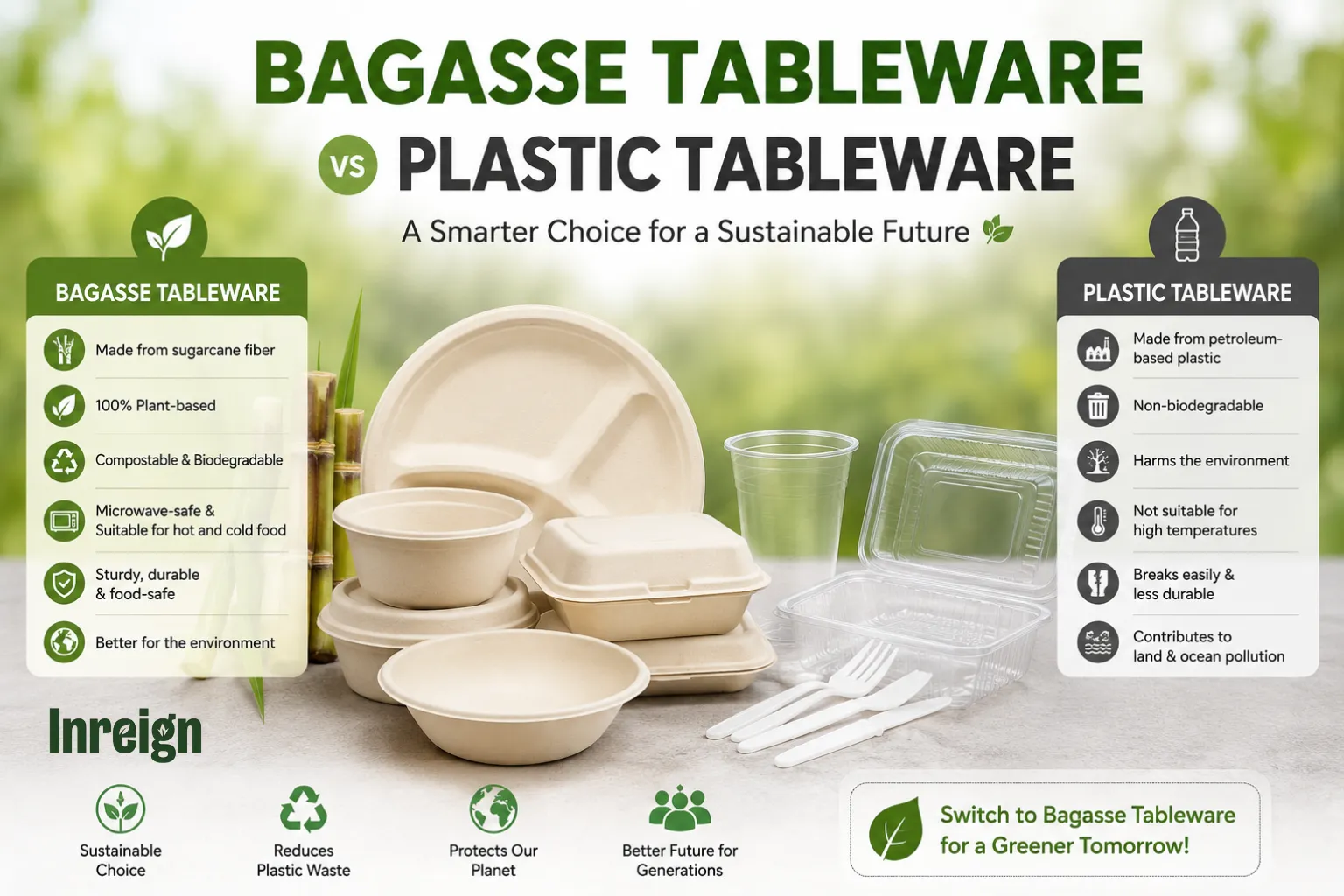
Plastic tableware has long been used by restaurants, cafés, catering companies, takeaway businesses, hotels, and event organizers because it is convenient, lightweight, and widely available. But as concerns about plastic waste continue to grow, businesses are looking for practical alternatives that better support their sustainability goals.
Bagasse tableware is one of the alternatives gaining attention. Made from the fibrous residue of sugarcane processing, it can be molded into plates, bowls, trays, and food containers for a variety of food-service applications.
But is bagasse really a better option than plastic? What are the benefits, and what should businesses consider before making the switch?
Let’s take a closer look.
What Is Bagasse Tableware?
Bagasse is the dry, fibrous material that remains after sugarcane is crushed to extract its juice. This material can be processed into pulp and molded into different food-service products.
Instead of allowing this agricultural by-product to go unused, manufacturers can transform the fibers into useful products such as:
- Plates
- Bowls
- Food containers
- Trays
- Clamshell containers
- Takeaway packaging
- Catering tableware
This makes bagasse tableware a plant-fiber-based option for businesses that want to explore alternatives to conventional disposable plastic.
Why Is Bagasse Becoming Popular?
The food-service industry uses a huge amount of disposable packaging and tableware. Restaurants and takeaway businesses need products that are convenient, functional, and suitable for different types of food.
At the same time, customers are paying more attention to packaging and environmental responsibility.
This combination has increased interest in materials such as sugarcane fiber. Bagasse tableware gives businesses an opportunity to replace some traditional disposable plastic products with products made from plant-based fibers.
It is not a solution to every waste problem, but it can be one practical part of a broader sustainable packaging strategy.
Bagasse and Plastic Come From Different Sources
One of the biggest differences between the two materials is where they come from.
Conventional plastic tableware is generally manufactured from plastic polymers, while bagasse products are made using sugarcane fiber.
Sugarcane processing produces large amounts of fibrous residue. Using this material to manufacture tableware gives it another useful application.
For businesses interested in plant-based materials, this is one of the main reasons to consider sugarcane bagasse tableware.
A Practical Alternative for Disposable Food Service
Businesses do not choose disposable tableware simply because of its environmental characteristics. The product also needs to work well in real-world conditions.
Restaurants need plates that can hold meals. Catering companies need lightweight products that can be transported easily. Takeaway businesses need containers that can protect food during delivery.
Modern bagasse tableware is available in different shapes, sizes, and designs, allowing businesses to select products according to their specific requirements.
Bagasse Plates for Restaurants and Events
Bagasse plates are one of the most common applications of sugarcane fiber.
They can be used for:
- Restaurant meals
- Catering services
- Weddings
- Corporate events
- Parties
- Festivals
- Outdoor gatherings
- Food-service operations
Different sizes and shapes can accommodate different types of meals, snacks, desserts, and servings.
For businesses that regularly use disposable plates, switching from conventional plastic to bagasse plates can be one way to introduce more plant-fiber-based products into their operations.
Bagasse Bowls for Different Foods
Bowls are another useful application.
Depending on the design and specifications, bagasse bowls can be used for salads, rice dishes, noodles, desserts, snacks, and other foods.
For restaurants and takeaway businesses, choosing the right bowl is important. The capacity, depth, strength, moisture resistance, and intended food application should all be considered.
Rather than choosing a product based only on its material, businesses should select bagasse bowls according to how they will actually be used.
Bagasse Food Containers for Takeaway
Takeaway and food delivery have become an important part of the food industry. Packaging needs to protect food while also being convenient for customers.
Bagasse food containers can be used for various meals, including rice dishes, curries, salads, pasta, snacks, and combination meals.
The appropriate container depends on the food being served. Hot, oily, or moisture-heavy foods may require products with specific performance characteristics.
This is why businesses should always check product specifications before selecting bagasse food containers for commercial use.
A Plant-Based Option for Sustainable Packaging
One of the strongest reasons businesses explore bagasse is its plant-based origin.
Sugarcane is a renewable agricultural resource, and bagasse is a by-product of sugarcane processing. Turning the fiber into food-service products creates an additional use for material generated during sugar production.
For businesses developing sustainable packaging strategies, this can be an attractive feature.
However, a plant-based material does not automatically mean that every product has the same environmental impact. Manufacturing, transportation, use, and disposal all need to be considered.
Is Bagasse More Sustainable Than Plastic?
This question requires a little more context.
Bagasse can provide a plant-fiber alternative to conventional plastic, and many products are designed with compostability in mind. However, the overall environmental performance of a product depends on its entire life cycle.
Important factors include:
- Where the raw material comes from
- How the product is manufactured
- Energy used during production
- Transportation requirements
- How the product is used
- How it is collected after use
- Whether suitable composting or waste facilities are available
Therefore, businesses should avoid making broad environmental claims without checking the actual product specifications.
Are Bagasse Products Compostable?
Many bagasse products are designed to be compostable under appropriate conditions. However, compostability can vary depending on the specific product.
Coatings, additives, manufacturing methods, and certifications can all affect how a product should be handled after use.
Businesses should check:
- Product certifications
- Manufacturer information
- Recommended disposal method
- Local composting facilities
- Applicable food-contact requirements
This is particularly important for businesses that want to communicate compostability claims to customers.
Can Bagasse Tableware Be Used for Hot Food?
Many products are designed for food-service applications involving hot food. However, the exact performance depends on the individual plate, bowl, or container.
Before serving very hot, oily, or liquid foods, businesses should check the manufacturer’s specifications for:
- Temperature resistance
- Oil resistance
- Moisture resistance
- Strength
- Recommended usage
Choosing the correct bagasse tableware for the intended application helps ensure that the product performs as expected.
Bagasse Tableware for Catering Businesses
Catering companies often need large quantities of disposable plates, bowls, and food containers.
Events such as weddings, conferences, corporate functions, festivals, and outdoor celebrations can require hundreds or thousands of pieces.
Because bagasse products are lightweight and available in different formats, they can be convenient for high-volume catering operations.
Businesses can select plates, bowls, trays, and containers according to their menu, serving style, and event requirements.
Why Restaurants Are Considering Bagasse
Restaurants are increasingly paying attention to the materials they use for food packaging and disposable tableware.
There are several reasons a restaurant may consider switching some products to bagasse:
- Customers are more aware of packaging choices
- Businesses want to reduce dependence on conventional plastic
- Sustainable packaging can support brand positioning
- Plant-fiber products offer another material option
- Takeaway and delivery businesses need large quantities of disposable packaging
For restaurants, the goal should not simply be to replace every plastic product. Instead, businesses can identify where bagasse tableware makes sense based on performance, cost, food type, and disposal options.
Bagasse vs Plastic: Which Should You Choose?
There is no single answer for every business.
Plastic may still be suitable for certain applications where specific performance characteristics are required. Bagasse can be a strong alternative for businesses looking for plant-fiber-based disposable products.
When comparing the two, consider:
Material: Do you prefer conventional plastic or plant-based fiber?
Food application: What type of food will the product hold?
Temperature: Will it be used with hot or cold food?
Moisture: Does the food contain sauces, liquids, or oils?
Strength: Does the product need to handle heavy portions?
End of life: What disposal options are available in your area?
Supplier: Can the supplier provide consistent quality and relevant product documentation?
Looking at these factors will help you choose the right product for your business rather than relying on a simple material comparison.
How to Choose Quality Bagasse Tableware
If you are planning to switch from plastic, don’t choose a product based only on appearance.
Look at the product’s dimensions, thickness, weight, capacity, strength, and intended application.
For food businesses, it is also important to ask suppliers about food-contact documentation and relevant certifications.
If you are buying in bulk, consider the supplier’s production capacity, consistency, delivery capabilities, product availability, and customer support.
A reliable supplier should be able to provide clear information about how the products are designed and intended to be used.
Why Choose Inreign?
At Inreign, we provide sustainable food-service and packaging solutions for businesses looking for alternatives to conventional disposable products.
Our range of plant-fiber-based products is suitable for different food-service environments, including restaurants, cafés, catering businesses, hotels, takeaway outlets, and events.
From plates and bowls to trays and food containers, our products are designed to provide practical options for businesses exploring more responsible packaging choices.
If you are considering moving away from conventional plastic, bagasse tableware can be an effective option to explore as part of your overall food-service packaging strategy.
Frequently Asked Questions
What is bagasse tableware?
Bagasse tableware is made from the fibrous residue left after sugarcane is processed for juice. The fibers can be converted into pulp and molded into plates, bowls, trays, and food containers.
Why choose bagasse tableware instead of plastic?
Businesses may choose bagasse because it provides a plant-fiber alternative to conventional plastic and can support sustainability-focused packaging strategies.
Is bagasse tableware compostable?
Many bagasse products are designed to be compostable under suitable conditions. However, the exact properties depend on the product, manufacturing process, coatings, certifications, and local facilities.
Can bagasse plates be used for hot food?
Many bagasse plates are designed for hot-food applications, but temperature resistance varies. Always check the manufacturer’s recommended usage conditions.
Is bagasse suitable for takeaway food?
Yes. Bagasse containers can be used for many takeaway applications, but businesses should select containers according to the food type, temperature, moisture, portion size, and transportation requirements.
Is bagasse better for the environment than plastic?
Bagasse provides a plant-fiber alternative to conventional plastic, but environmental performance depends on the complete life cycle of the product and how it is managed after use.
Conclusion
The growing demand for sustainable packaging is encouraging food businesses to look beyond conventional plastic. Bagasse tableware offers a plant-based alternative made from sugarcane fiber and can be used for plates, bowls, trays, and food containers.
For restaurants, caterers, hotels, cafés, takeaway businesses, and event organizers, it provides an opportunity to explore disposable food-service products that align with a greater focus on sustainable materials.
The best choice will always depend on the specific application. Before switching, businesses should consider food type, temperature, strength, moisture resistance, certifications, supplier reliability, and end-of-life options.
For businesses looking for practical alternatives to conventional plastic, bagasse tableware is certainly worth considering.
Stay Connected With Inreign
Follow Inreign on Facebook and Instagram for updates on bagasse tableware, sustainable food packaging, new product launches, and eco-friendly solutions for restaurants, catering businesses, hotels, and food-service companies.



 by
by