
As businesses and consumers increasingly look for sustainable alternatives to single-use plastics, compostable bagasse packaging has emerged as one of the most practical solutions for the food service industry. Made from sugarcane fiber left behind after juice extraction, bagasse packaging gives agricultural waste a second life while reducing dependence on conventional plastic.
In this guide, you’ll learn what bagasse packaging is, how it’s manufactured, its benefits, common applications, and why it has become the preferred choice for restaurants, cafés, caterers, hotels, and food delivery businesses worldwide.
What Is Compostable Bagasse Packaging
Compostable bagasse packaging is food packaging made from sugarcane bagasse, the fibrous residue left after extracting juice from sugarcane. Instead of being discarded or burned, this renewable agricultural by-product is processed into durable products such as food containers, plates, bowls, trays, cups, and takeaway boxes.
Bagasse packaging is widely valued because it is:
| Feature | Details |
|---|---|
| Material | Sugarcane Bagasse Fiber |
| Renewable | Yes |
| Plastic-Free | Yes |
| Compostable | Yes (under appropriate composting conditions) |
| Microwave Safe | Yes |
| Freezer Safe | Yes |
| Oil & Grease Resistant | Yes |
| Suitable For | Restaurants, Catering, Food Delivery, Hotels & Events |
Why Is Compostable Bagasse Packaging Growing in Popularity?
Plastic waste has become one of the world’s most pressing environmental concerns. Every year, millions of tonnes of single-use plastic packaging end up in landfills, waterways, and oceans, where they can persist for decades or even centuries.
As governments introduce stricter regulations on disposable plastics and consumers become more environmentally conscious, businesses are actively searching for packaging solutions that combine performance with sustainability.
Bagasse packaging has gained significant popularity because it offers many of the functional benefits of conventional disposable packaging while making use of an existing agricultural by-product.
Unlike petroleum-based plastics, bagasse products are manufactured from sugarcane fiber, helping convert agricultural residue into useful food-service packaging.
Why Businesses Prefer Bagasse Packaging
Businesses across the food industry are switching to bagasse packaging because it offers several practical advantages:
- Made from renewable sugarcane fiber
- Plastic-free construction
- Suitable for both hot and cold foods
- Microwave-safe
- Freezer-safe
- Strong and durable
- Resistant to oil and grease
- Professional, premium appearance
- Supports sustainability initiatives
These qualities have made bagasse one of the fastest-growing materials used for disposable food packaging across restaurants, cafés, catering businesses, supermarkets, airlines, and food delivery services.
What Is Bagasse?
Many people assume bagasse is a specially cultivated plant, but it is actually a natural by-product of sugar production.
After sugarcane stalks are crushed to extract juice, a dry, fibrous material remains. This material is known as bagasse.
For many years, bagasse was considered agricultural waste. Today, manufacturers transform it into valuable molded fiber products, helping maximize the use of harvested sugarcane while reducing waste.
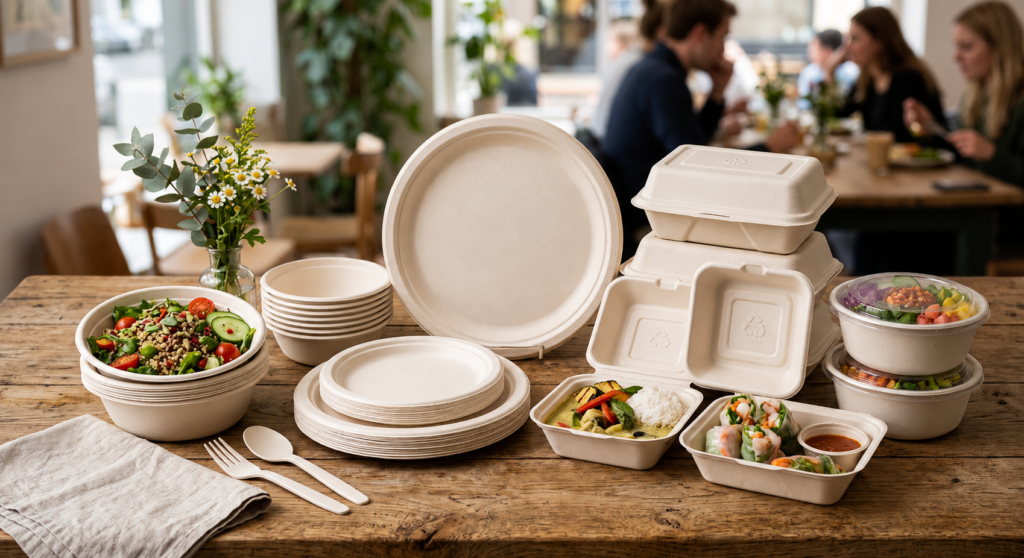
Common products made from bagasse include:
- Food containers
- Plates
- Bowls
- Meal trays
- Clamshell boxes
- Cups
- Packaging inserts
- Industrial molded fiber products
By converting agricultural residue into useful packaging, bagasse supports a more circular approach to resource utilization.
Why Is Bagasse an Ideal Packaging Material?
Bagasse naturally possesses several characteristics that make it well suited for food-service packaging.
It is:
- Lightweight
- Strong
- Moldable
- Heat resistant
- Breathable
- Made from a renewable resource
Once cleaned and processed into pulp, the fibers can be molded into a wide variety of packaging products without relying on conventional petroleum-based plastics.
The result is practical, high-performance packaging designed to meet the needs of modern food businesses.
Bagasse at a Glance
| Property | Value |
|---|---|
| Source | Sugarcane Fiber |
| Raw Material | Agricultural By-product |
| Renewable | Yes |
| Recyclable | Where suitable recycling facilities exist |
| Compostable | Under appropriate composting conditions |
| Food Contact | Commonly manufactured for food-service applications, subject to applicable regulations |
How Is Bagasse Packaging Made?
One of the reasons bagasse packaging is considered a sustainable alternative is that it utilizes a material already generated during sugar production.
Instead of treating sugarcane fiber as waste, manufacturers convert it into molded fiber packaging through a carefully controlled production process.
Step 1: Sugarcane Harvesting
Sugarcane is cultivated primarily for sugar production. Once harvested, the stalks are transported to sugar mills for processing.
Step 2: Juice Extraction
The harvested stalks pass through crushing rollers to extract sugar-rich juice.
After extraction, the remaining fibrous residue becomes bagasse, the primary raw material used for manufacturing compostable food packaging.
Suggested Image: Sugarcane crushing process showing bagasse being separated.
Step 3: Cleaning the Fibers
The collected bagasse is thoroughly cleaned to remove impurities and prepare the fibers for pulping.
This stage helps ensure product consistency and quality.
Step 4: Pulp Production
The cleaned fibers are processed into pulp, which serves as the base material for molded fiber packaging.
From this pulp, manufacturers produce:
- Plates
- Bowls
- Food containers
- Meal trays
- Takeaway boxes
- Packaging inserts
Step 5: Molding
The pulp is poured into precision-engineered molds.
Using heat and pressure, the fibers bond together to form rigid, durable packaging products in a variety of shapes and sizes.
Step 6: Trimming and Quality Inspection
After molding, each product undergoes trimming and inspection to ensure it meets quality standards.
Manufacturers typically check:
- Surface finish
- Structural strength
- Dimensional accuracy
- Product consistency
Only products that pass quality checks proceed to the next stage.
Step 7: Packaging and Distribution
Finished products are packaged and shipped to businesses worldwide, including:
- Restaurants
- Food delivery companies
- Hotels
- Supermarkets
- Catering businesses
- Export markets
They are then ready for commercial food-service applications.
Suggested Image: Automated production line packaging finished bagasse products.
Why This Matters
Bagasse packaging demonstrates how agricultural by-products can be transformed into practical, high-performance food packaging. By utilizing sugarcane fiber that would otherwise have limited value, manufacturers reduce reliance on virgin plastic while supporting a more resource-efficient production cycle.
For businesses, adopting compostable bagasse packaging can help align with sustainability goals, respond to changing consumer expectations, and prepare for evolving regulations on single-use plastics.
Frequently Asked Questions
Is bagasse packaging compostable?
Yes. Bagasse packaging is compostable under appropriate composting conditions. The time required depends on factors such as temperature, moisture, and the composting system used.
Can bagasse containers be microwaved?
Yes. Most bagasse food containers are microwave-safe, making them suitable for reheating food. Always follow the manufacturer’s usage guidelines.
Is bagasse packaging suitable for hot and cold foods?
Yes. Bagasse packaging is designed to handle both hot and cold foods and is commonly used for takeaway meals, salads, desserts, and beverages.
Is bagasse better than plastic packaging?
Bagasse is made from a renewable agricultural by-product and is compostable under suitable conditions, whereas conventional plastic is derived from fossil fuels and can persist in the environment for long periods. The most suitable choice depends on the intended application, performance requirements, and available waste management infrastructure.



 by
by